Views: 0 Author: Site Editor Publish Time: 2026-10-31 Origin: Site


A sophisticated assembly line suddenly halts. The culprit? A single, inexpensive electromechanical component welded shut. In industrial automation, automotive systems, and advanced electronics, electrical relays form the critical switching backbone. They safely control massive power circuits using tiny command signals. Yet, an electrical relay is only as reliable as its contact materials.
Premature failure, catastrophic overheating, or signal loss rarely stem from electromagnetic coil defects. Instead, these costly downtimes usually happen because the wrong contact metallurgy was specified for the load. When these microscopic metal surfaces degrade, your entire control system goes down.
This engineering guide explores the intricate metallurgy of silver alloys, the physics behind constriction resistance, and the practical principles required to maximize switching reliability. Whether you are designing a new control circuit or sourcing durable components for mass production, mastering these materials ensures you make the right purchasing decision. Balancing upfront component costs with long-term operational stability remains the ultimate goal.
Material Matters: Chemical composition and metallurgical structure directly dictate electrical lifespan, arc resistance, and thermal conductivity.
Silver Alloys Dominate the Industry: Advanced composite materials like Silver Tin Oxide and Silver Nickel have largely replaced pure silver. They serve as modern, environmentally safe alternatives to toxic legacy materials.
Contact Resistance is Critical: Maintaining low and stable resistance prevents thermal runaway and voltage drops. This is especially true in sensitive circuits where minor fluctuations cause signal degradation.
Load Type Dictates Choice: Selecting the correct component requires strictly matching the metal to the specific load profile. Resistive, inductive, capacitive, and dry circuit loads all demand different metallurgical properties.
Gold is Mandatory for Low-Level Signals: Gold-plated contacts are strictly required for low-level circuits to prevent oxidation. However, this plating will quickly vaporize if subjected to high-power electrical loads.
Think of relay contacts as the conductive bridge inside a switching mechanism. When the coil energizes, magnetic force snaps the armature. The movable contact strikes the stationary one to make or break an electrical circuit. In milliseconds, this gap must transform from a complete dielectric insulator into a highly efficient conductor.
The environment inside a functioning relay is exceptionally hostile. Every time contacts snap shut, they endure severe mechanical impact forces. Over time, this causes physical deformation. Furthermore, breaking an active load triggers electrical arcing. The current ionizes the air gap, forming a localized plasma bridge. Temperatures can spike to thousands of degrees Celsius instantly. This thermal shock heavily stresses the metallurgical integrity of the metal.
The physical and chemical properties of the chosen metal determine the ultimate reliability of the device. An optimal material must possess high electrical conductivity to minimize energy loss. It needs high thermal conductivity to dissipate heat. It also requires sufficient mechanical hardness to resist physical wear. The surface must resist fusing under high heat and maintain a consistent flow of electricity over millions of mechanical cycles. Choosing the wrong alloy guarantees premature failure.
Looking at current industry trajectories, the demand for robust relay contact materials is shifting rapidly. The explosion of electric vehicles, solar inverters, and smart grid applications requires components capable of handling massive direct current loads and brutal inrush currents. Consequently, manufacturers are moving away from legacy heavy metals.
Strict environmental regulations have essentially eliminated cadmium-based alloys across global markets. Today, advanced composite materials like Silver Tin Oxide dominate the landscape. They offer superior arc-quenching capabilities without ecological damage, aligning perfectly with the global push toward sustainable manufacturing and miniaturization of high-power control boards.
Fine silver possesses the highest electrical and thermal conductivity of any known metal. Theoretically, this makes it the perfect medium for electrical transmission. Pure silver, however, is rarely utilized alone in high-power switching applications. Because it is exceptionally soft, it is prone to mechanical wear and contact welding under heavy inrush currents. Pure silver is also highly susceptible to sulfidation. Exposure to ambient sulfur creates an insulating tarnish film that severely degrades performance.
To harness the unmatched conductivity of silver while mitigating its physical weaknesses, metallurgists utilize advanced alloying and powder metallurgy techniques. By integrating secondary elements such as Nickel or Tin Oxide into the silver matrix, engineers create advanced composite alloys. These secondary elements pin the grain boundaries of the silver. This significantly increases mechanical toughness, elevates the melting point, and provides vital arc-quenching properties.
Silver remains a precious metal subject to market volatility. The exact choice of alloy represents a critical engineering balance between budget constraints and required system reliability. High-performance composites require complex manufacturing processes, which increases upfront costs. However, they offer exponential improvements in lifespan for demanding applications. This proves highly cost-effective over the product lifecycle.
Understanding distinct material properties is crucial for engineers when specifying components for new designs. The right choice prevents field failures.
Fine silver offers the lowest initial constriction resistance. It is highly effective for low-to-medium current applications under 10 amps with purely resistive loads. Because it is vulnerable to sulfidation and mechanical deformation, its use is generally restricted to sealed environments completely devoid of high inrush currents.
Typically containing 10 to 20 percent Nickel, this alloy is the undisputed industry standard for general-purpose switching. The addition of nickel hardens the base metal, offering excellent resistance to mechanical wear and material transfer. Silver Nickel is ideal for moderate resistive and slightly inductive loads. It provides a highly stable, predictable lifespan in standard consumer electronics.
Silver Tin Oxide stands as the modern powerhouse of contact metallurgy. It exhibits vastly superior resistance to extreme inrush currents and contact welding compared to other options. This makes it the premier choice for capacitive loads, switch-mode power supplies, and LED lighting drivers where initial current spikes can hit 100 times the steady-state current. It is the globally recognized replacement for toxic cadmium-based alloys.
Historically, Silver Cadmium Oxide was the definitive standard for heavy-duty switching. As the contacts arced, the cadmium would vaporize, actively absorbing heat and quenching the electrical arc. While its performance remains excellent for heavy motor loads, it is being aggressively phased out worldwide due to strict environmental regulations regarding cadmium toxicity.
For applications involving micro-ampere currents and voltages typically below 5V, a thin layer of gold is electroplated over a base alloy. Gold is chemically inert, granting it absolute immunity to oxidation. In low-power signal switching, there is insufficient electrical energy to punch through standard silver tarnish. Gold ensures flawless signal integrity. Conversely, if subjected to high power, this microscopic gold layer instantly vaporizes.
Material Type | Optimal Load Type | Key Advantage | Primary Limitation |
|---|---|---|---|
Fine Silver | Low-to-Medium Resistive | Lowest initial resistance. | Soft; prone to welding and sulfidation. |
Silver Nickel | Medium Resistive or Inductive | Excellent wear resistance; highly stable. | Not suitable for extreme inrush currents. |
Silver Tin Oxide | Capacitive or High Inrush | Superior anti-welding properties. | Slightly higher initial resistance. |
Silver Cadmium Oxide | Heavy Inductive or Motor | Excellent arc quenching. | Toxic; restricted by global laws. |
Gold-Plated | Dry Circuits or Signal Logic | Immune to oxidation; pure signal. | Gold layer vaporizes under high power. |
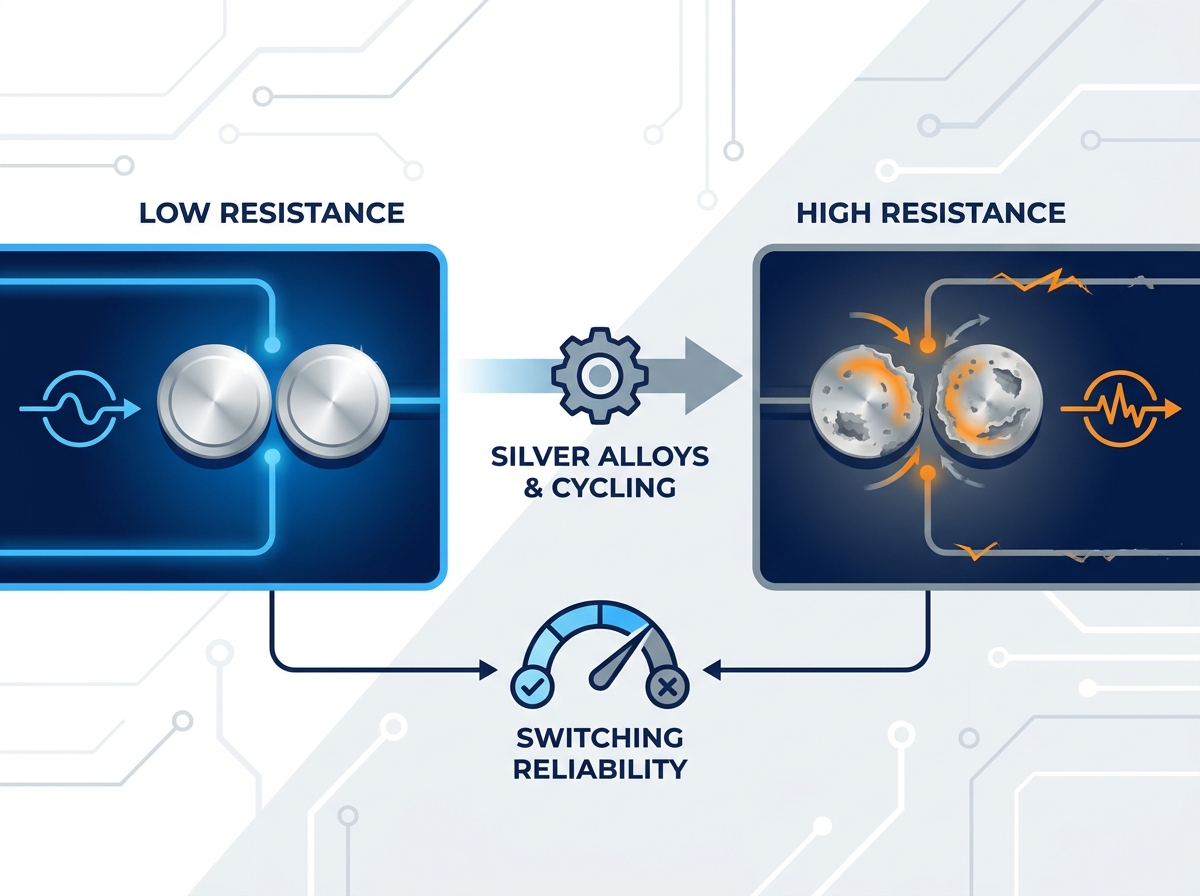
Even perfectly flat metal surfaces consist of microscopic peaks and valleys called asperities. Current only flows through the tiny points where these peaks touch. This natural bottleneck creates constriction resistance, forming the baseline of overall contact resistance.
Environmental factors severely impact switching efficiency over time. Exposure to ambient humidity, airborne dust, and sulfur causes chemical reactions on silver alloys. This creates thin, non-conductive films of silver sulfide. In enclosed industrial environments, outgassing from surrounding plastics deposits invisible organic films. This film resistance stacks on top of the constriction resistance, driving total impedance higher.
The critical relationship between resistance and heat generation is governed by Joule's law. Power equals Current squared times Resistance. If impedance rises due to oxidation, high currents generate exponential heat. A 30-amp load pushing through severely oxidized components with just 0.1 ohms of resistance generates 90 watts of localized heat. The plastic housing melts. The system fails catastrophically.
To combat insidious film buildup, advanced mechanisms feature a sliding action. Instead of merely pressing straight down, the mechanical armature forces the movable contact to slide slightly across the stationary one upon closure. This mechanical friction physically scrapes away microscopic layers of oxidation, exposing fresh metal and keeping the electrical pathway clear.
When a circuit is interrupted under load, current attempts to keep flowing across the newly formed air gap. High voltage potential ionizes the air, creating a conductive plasma bridge. Acting like a miniature lightning bolt, this extreme thermal event melts the surface of the alloy, gradually burning away the material.
In direct current circuits, electrical arcing flows consistently in one direction. Intense electron bombardment vaporizes metal from the anode and deposits it onto the cathode. Over millions of cycles, a deep pit forms on one side and a jagged spike on the other. Eventually, the spike physically locks into the pit, jamming the device closed.
Welding represents a catastrophic failure mode where the relay becomes permanently stuck. This typically occurs upon closure when switching loads with massive inrush currents, like uncharged capacitors. The sudden surge of electrical energy instantly melts the microscopic asperities. As the metal cools fractions of a second later, the two surfaces fuse into a solid metallurgical weld.
When the armature slams the contacts together, kinetic energy causes them to physically rebound and reconnect multiple times. This rapid phenomenon is known as contact bounce. Each microscopic bounce initiates a new electrical arc, multiplying the thermal degradation associated with a single switching cycle.
Selecting the optimal material requires a rigorous analysis of your specific load profile. Engineers must evaluate steady-state current, critical transient states, and the nature of the load.
For telecommunications, PLC logic inputs, and sensitive sensor signals, the electrical energy is too low to punch through natural silver oxidation. Specify gold-plated bifurcated contacts here. The twin design provides redundant physical touchpoints, while the gold plating ensures absolute immunity to corrosion.
Resistive loads, such as industrial heating elements, draw a steady current without significant inrush spikes. For these highly predictable scenarios, Silver Nickel is the optimal choice. It provides excellent wear resistance and stable conductivity over a long operational lifecycle.
Components like electric motors resist changes in current flow. When a relay attempts to turn off an inductive load, the collapsing magnetic field generates a massive high-voltage spike that violently forces an electrical arc across the opening gap. To survive this severe erosion, specify Silver Tin Oxide for superior arc-quenching resilience.
When designing modern LED power supplies, engineers face massive inrush currents upon startup. An uncharged capacitor acts as a brief short circuit. This extreme surge easily welds standard silver. For these applications, specify heavy-duty components. For instance, high-power electromagnetic relays rated for 30A or 40A switching capability typically utilize optimized Silver Tin Oxide structures to survive these exact thermal shocks.
Robust metallurgy is rarely enough for heavy inductive loads. Engineers must implement external circuit protections to actively mitigate arcing. Utilizing snubber circuits, flyback diodes for direct current loads, and metal oxide varistors helps absorb destructive energy spikes before they erode internal components.
The operating environment dictates the required enclosure rating. To protect internal metals from harsh environments, select appropriate sealing. Flux-tight enclosures protect against automated soldering processes. Wash-tight or hermetically sealed relays prevent ambient sulfur and moisture from causing insidious oxidation.
A common engineering pitfall is deploying a heavy-duty 30A relay to switch a delicate 10mA sensor signal. High-power silver alloys naturally develop a thin oxide layer that requires a minimum wetting current, such as 100mA, to punch through. The 10mA signal lacks the energy to break this barrier, resulting in a false open circuit. Always size the component appropriately.
System reliability hinges on microscopic metallurgical interactions. Understanding silver alloy properties, actively managing contact resistance, and implementing arc mitigation strategies are non-negotiable for long-term stability. Never select a component based purely on its maximum amperage rating. Load behavior dictates material survival.
When you are ready to finalize your control circuit design, ensure you source components engineered for your exact load profile. Explore the comprehensive range of high-performance products at NNC Relay. Visit our product catalog to find the exact industrial control relays and custom solutions designed to keep your automated systems running flawlessly.
Silver contacts are highly conductive and engineered for medium to high-power switching, though they are susceptible to natural tarnishing. Gold contacts are highly resistant to oxidation and environmental corrosion, making them flawless for low-level signal circuits. However, gold has a low melting point and will quickly burn away if subjected to high-power arcing.
Wetting current is the minimum amount of electrical energy required to successfully break through the natural oxidation layer that forms on silver alloy contacts. If the applied current is too low to punch through this microscopic film, the relay may fail to close the circuit electrically, even if the metals have physically touched.
Contact welding is predominantly caused by abnormally high inrush currents, which are common with capacitive loads, LED drivers, or electric motors. This intense surge melts the material instantly. Upgrading to a weld-resistant material like Silver Tin Oxide or integrating an external inrush current limiter resolves this failure mode.
High contact resistance creates a physical bottleneck for current flow. According to Joule's law, this resistance results in a localized voltage drop across the relay and generates excess thermal energy. In micro-electronics, this causes critical signal loss. In high-power circuits, the excess heat causes catastrophic thermal failure and melting.
For open-frame industrial relays, maintenance technicians sometimes use specialized burnishing tools to gently scrape away heavy oxidation without leaving abrasive residue. However, for modern sealed relays used in most electronics, cleaning is impossible. Once the internal resistance rises beyond acceptable limits, the entire component must be replaced.
Lifespan is divided into mechanical and electrical ratings. A standard relay might boast a mechanical life of 10 million cycles without any load applied. However, its electrical life under full load might be rated for only 100,000 cycles. Electrical lifespan drops drastically if the component switches loads featuring high inrush currents or severe arcing.
While historically favored for exceptional arc-quenching capabilities under heavy loads, Silver Cadmium Oxide is largely being phased out globally. It is strictly restricted in many regions under RoHS directives due to severe environmental and health hazards associated with cadmium toxicity. Silver Tin Oxide is the universally recommended eco-friendly alternative.

 注: 建议图片大小150px*50px


