Views: 0 Author: Site Editor Publish Time: 2026-10-14 Origin: Site


Picture this familiar scenario. You are finalizing the design for an automated control system, and a complex wiring schematic sits on your desk. You reach a critical crossroads. Selecting a reliable switching component to control your electrical loads is essential. A wrong choice could lead to premature failure, costly downtime, or severe safety hazards. For engineers and automation specialists, this high-stakes decision is a daily reality.
For decades, electromechanical relays served as the undisputed industry standard for switching circuits. Technology, however, has evolved significantly. Modern applications increasingly demand faster response times and extended operational lifespans. Traditional mechanical switches are frequently pushed to their absolute limits. This shift in operational demands has brought semiconductor-based switching directly into the spotlight.
Recent market trends highlight a massive shift toward automation and smart manufacturing, often referred to as Industry 4.0. Market analyses reveal a surging demand for high-speed, reliable switching components. This surge is largely driven by the rapid expansion of electric vehicle charging infrastructure, renewable energy grids, and advanced precision robotics. Engineers are migrating away from mechanical contacts to meet these rigorous modern standards. By the end of this extensive breakdown, you will know exactly whether your specific project calls for semiconductor technology or if traditional mechanical options remain your best choice.
Advanced Semiconductor Switching: These devices utilize advanced semiconductor technology to switch electrical currents. Featuring zero moving parts, they offer a significantly longer operational lifespan compared to traditional mechanical relays.
High-Frequency Performance: They deliver lightning-fast switching speeds and operate in complete silence. This makes them the superior choice for high-frequency applications like PID temperature control and precision robotics.
Thermal Management Requirements: Despite their numerous engineering advantages, these devices naturally generate internal heat during operation. Rigorous thermal management through properly sized heat sinks is required to prevent thermal runaway.
Safety and Isolation Limits: Semiconductor switches are susceptible to minor leakage current and voltage transients. They are not the appropriate choice when safety regulations mandate absolute physical circuit isolation.
Application-Specific Selection: The final decision ultimately depends on your project's specific switching frequency, thermal environment, budget, and safety constraints.
To make an informed engineering decision, understanding the underlying architecture of these devices is essential. Unlike traditional relays relying on magnetic coils to physically pull metal contacts together, a solid-state device operates entirely on the microscopic level using semiconductor materials. This fundamental difference in design eliminates mechanical wear and tear. It fundamentally reshapes how engineers approach circuit control.
Providing electrical isolation between the low-power control signal and the high-power load circuit is a critical function of any relay. Solid-state devices achieve this crucial isolation without physical contacts. They use an internal component called an optocoupler.
Specifically, applying a small control voltage to the input side powers an internal infrared Light Emitting Diode. This diode shines a beam of light across a microscopic insulating gap. A photosensitive semiconductor sensor sits on the opposite side. Upon detecting the light, the sensor triggers the output side to allow current to flow to the load. This optical isolation is absolutely vital for system integrity. It ensures that high-voltage AC loads cannot backfeed into and destroy sensitive microcontrollers or industrial Programmable Logic Controllers.
Once the optical signal bridges the isolation gap, robust semiconductor components handle the heavy lifting of switching the electrical load. The specific components utilized depend heavily on the load type. For alternating current loads, these devices typically utilize Thyristors or TRIACs. Direct current models rely on Power MOSFETs.
Because there is no physical armature to swing closed and no metal contacts to slam together, the switching action occurs almost at the speed of electrons. This lack of physical movement allows for instantaneous and highly reliable switching. Furthermore, it completely eliminates contact bounce. Contact bounce is a notorious issue in mechanical relays causing rapid, unintended micro-switching that sends erratic electrical noise through a circuit. Utilizing semiconductors guarantees a clean and immediate connection.
When designing a control panel, the decision often boils down to choosing between a modern semiconductor solution and a traditional electromechanical relay. Directly comparing their performance metrics helps clarify which component truly belongs in your specific application.
Feature | Solid State Architecture | Electromechanical Architecture |
|---|---|---|
Switching Speed | Microseconds (Extremely Fast) | Milliseconds (Relatively Slow) |
Moving Parts | None | Yes (Magnetic coil, springs, contacts) |
Lifespan | Virtually infinite (if cooled correctly) | Limited by mechanical wear |
Operating Noise | Completely silent | Audible clicking |
Arcing / Sparks | None | Common during high-load switching |
Thermal Output | Generates significant internal heat | Generates minimal heat |
Electrical Isolation | Optical (Microscopic leakage current exists) | Physical air gap (True isolation) |
The most glaring difference between these two technologies is their reaction time. A standard mechanical relay relies on electromagnetism to move a metal lever. This action takes time, typically ranging from 5 to 15 milliseconds. While this sounds fast to the human ear, it is an absolute eternity in the world of high-speed automation.
In stark contrast, semiconductor-based relays respond in mere microseconds. This near-instantaneous reaction time allows them to switch on and off hundreds of times per second. Attempting to switch a mechanical relay at such high frequencies would cause the physical contacts to rapidly degrade, overheat, and eventually weld shut. For high-frequency switching, semiconductor relays operate effortlessly where mechanical counterparts would face rapid destruction.
In industrial engineering, reliability is frequently measured by Mean Time Between Failures. Mechanical relays are inherently rated for a specific number of mechanical cycles. This rating often hovers around 100,000 to 1,000,000 actuations under a full electrical load. Once reaching this threshold, internal springs weaken, and contacts become pitted from electrical arcing.
Because semiconductor switches have absolutely no moving parts to degrade, their lifespan is not measured in switching cycles. If operated strictly within specified electrical ratings and kept adequately cool, their lifespan is virtually infinite. This unparalleled durability makes them a staple in environments where maintenance access is difficult or system downtime is prohibitively expensive.
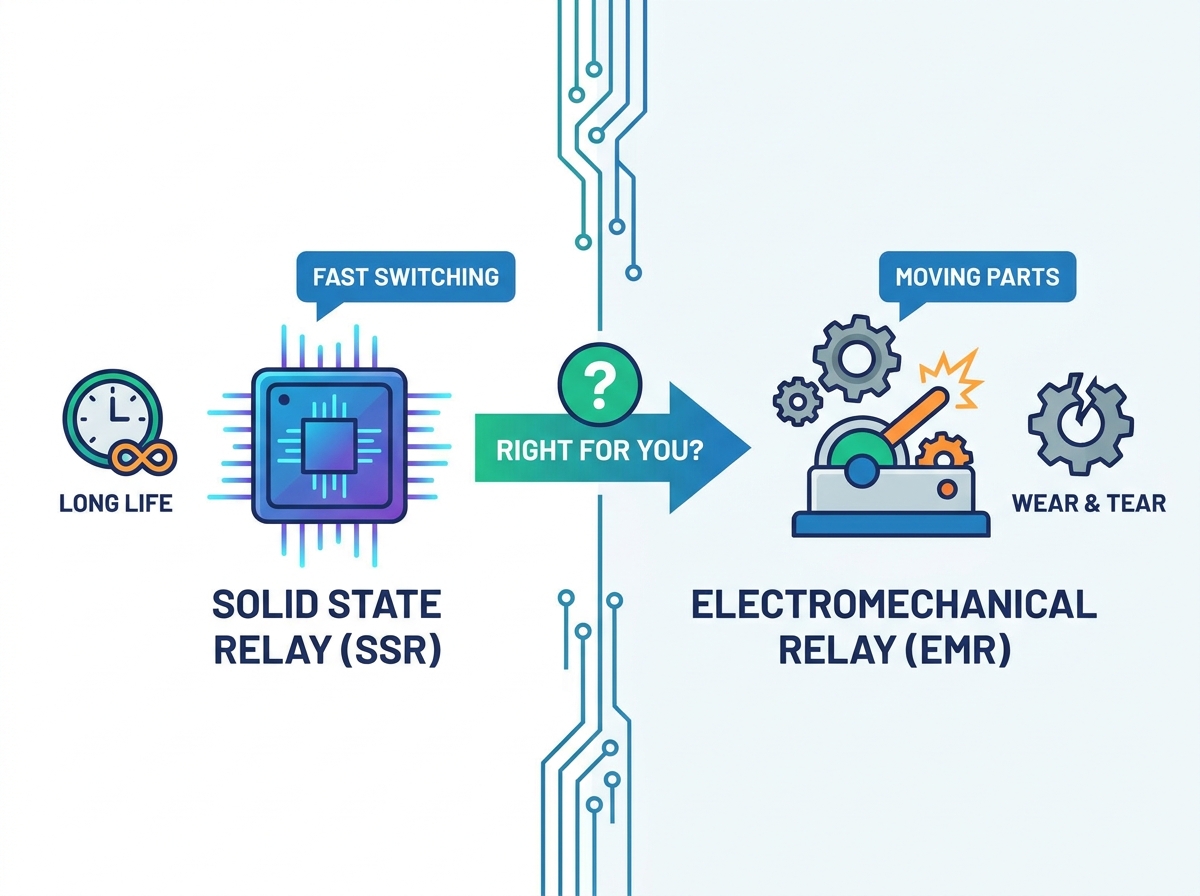
Understanding the core benefits of semiconductor-based switching can validate your interest in upgrading from legacy mechanical systems. The advantages extend far beyond mere switching speed. They offer robust solutions for complex engineering challenges.
The economic implications of infinite switching cycles are substantial. On a bustling factory floor, a mechanical relay controlling a fast-moving conveyor belt might need replacement every few months due to mechanical exhaustion. This constant replacement cycle requires purchasing spare parts, paying maintenance technicians, and suffering through costly production halts.
By implementing a solid-state solution, facilities can drastically reduce their maintenance overhead. The install-and-forget nature of a reliable solid state relay provides long-term stability that easily offsets the initial purchase price. This keeps heavy machinery and manufacturing lines running uninterrupted for years.
Mechanical relays are notoriously noisy, often producing a disruptive click that echoes through quiet environments. Semiconductor alternatives operate in absolute silence. This acoustic advantage makes them highly desirable for precision medical equipment, recording studios, and modern smart home integrations.
Furthermore, mechanical contacts opening under a high electrical load often draw an electrical arc. This arc is a literal spark of plasma. In hazardous environments containing flammable gases, volatile chemicals, or combustible dust, a single rogue spark can trigger a catastrophic explosion. Because electricity is switched internally through a solid semiconductor material, there is absolutely no arcing. This makes them intrinsically safer for volatile industrial locations.
Electrical noise can wreak havoc on sensitive digital equipment. It causes sensors to read inaccurately or microcontrollers to crash unexpectedly. To combat this, AC-rated devices often feature zero-cross switching technology.
Zero-cross models monitor the alternating current sine wave. They wait to turn on or off until the exact millisecond the AC voltage crosses the zero-volt mark. Switching the load when there is zero voltage prevents massive surge currents. This synchronized switching significantly reduces electromagnetic interference, safeguarding surrounding delicate electronics.
To make an informed purchasing decision, recognizing that semiconductor switches are not a flawless solution for every conceivable scenario is crucial. They come with specific engineering limitations that must be respected during the circuit design phase.
The most significant drawback of semiconductor switching is internal power loss. When current flows through the internal Thyristors or MOSFETs, there is a natural forward voltage drop. This drop typically hovers between 1.0 and 1.5 volts. Multiplying this voltage drop by the current flowing through the relay results in wasted energy expelled as heat.
For instance, switching a heavy 40-amp industrial heater with a 1.5-volt drop results in 60 watts of pure heat generated inside a compact plastic housing. If this heat is not actively removed, the internal semiconductor will quickly exceed its maximum operating temperature. This leads to catastrophic thermal runaway and permanent failure. Failing to use a properly sized aluminum heat sink and thermal conductive compound is the leading cause of premature failure in the field.
Unlike a mechanical switch creating a physical air gap when turned off, a semiconductor is never truly off. Even in the resting state, a microscopic amount of electricity known as leakage current continues to flow. While this leakage is usually just a few milliamperes, it poses a severe shock hazard to maintenance workers falsely assuming the circuit is entirely dead.
In addition, these components are highly sensitive to sudden voltage spikes on the power line. A spike from a lightning strike or a large industrial motor shutting off can accidentally trigger the relay to turn on for a fraction of a second. Worse, it can permanently puncture the semiconductor. Proper circuit protection like RC snubbers or Metal Oxide Varistors is often mandatory to shield the system.
Traditional mechanical relays are incredibly cheap to mass-produce. They often cost a fraction of the price of an equivalent semiconductor relay. Factoring in the mandatory accessories required for thermal management, the initial installation cost is noticeably higher. For highly budget-constrained projects not requiring rapid switching, justifying this financial premium can be difficult.
Given their specific strengths and weaknesses, these devices dominate certain industries where mechanical alternatives simply cannot survive the operational stress.
Maintaining precise temperatures in commercial equipment requires advanced Proportional-Integral-Derivative control methods. In demanding applications like plastic injection molding machines or high-end commercial ovens, the heating element cannot simply be turned on and left on. The controller must rapidly pulse the heater on and off to maintain an exact temperature without overshooting.
This rapid continuous pulsing would destroy a mechanical relay in a matter of days. Therefore, semiconductor-based relays stand as the undisputed standard for industrial heating control.
Modern manufacturing relies heavily on speed, repetition, and precision. Robotics, computer numerical control machining centers, and automated packaging lines require valves and actuators to trigger instantly over millions of cycles. Similarly, dynamic lighting controls depend on constant, rapid switching to function correctly. In any scenario where a load must be cycled rapidly and reliably for years, solid-state technology is the required engineering choice.
Establishing clear design boundaries is essential for safety and efficiency. There are specific scenarios where utilizing a semiconductor switch is potentially dangerous or non-compliant with strict engineering codes.
If local safety regulations or strict engineering codes require a verifiable physical air gap to ensure absolute zero electrical power flows to a machine during maintenance, semiconductor switches cannot be used. Because of the microscopic leakage current, the circuit is never truly isolated from the power grid. Heavy-duty electromechanical relays must be utilized to physically break the circuit and protect human lives in these critical safety scenarios.
These devices generate internal heat and rely heavily on heat sinks to survive. They are incredibly dependent on the ambient temperature of their surrounding environment. If your control panel is located next to a blast furnace or enclosed in a sealed unventilated box, the ambient air may simply be too hot to cool the device.
Furthermore, if a project is highly price-sensitive and only requires infrequent switching, the extra cost and complexity of thermal management are entirely unnecessary. A low-cost mechanical relay serves perfectly well in less demanding contexts.
Determining that your project requires the speed and durability of solid-state technology is only the first step. Selecting the exact correct component is critical. Purchasing the wrong type will inevitably result in immediate failure.
The most critical rule of selection is matching the relay to your specific load type. Internal semiconductors are highly specialized. An AC-rated device utilizes TRIACs designed exclusively to switch alternating current. It cannot turn off a DC load. Conversely, a DC model uses MOSFETs tailored for direct current. Applying AC voltage to a DC model will instantly destroy it. Always verify your power source and load type before making a selection.
When specifying an AC relay, you will encounter two primary switching types tailored to different electrical loads.
Zero-crossing models are ideal for resistive loads such as heating elements and incandescent lighting. They intelligently wait for the AC voltage to hit zero before switching. This minimizes electrical noise and prevents massive surge currents.
Random turn-on models switch instantly the moment the control signal is applied. These are absolutely necessary for highly inductive loads such as large AC motors or transformers. In these applications, voltage and current are out of phase, and waiting for a zero-cross could cause operational issues.
Never implement a high-current switch without concurrently planning your thermal management strategy. Leading manufacturers in industrial control systems, such as NNC, provide comprehensive thermal derating curves for their high-capacity series. For example, when deploying a heavy-duty 120A industrial component, engineers must account for approximately 1 to 1.5 watts of heat generated per ampere of load current. Running a continuous 80-amp load means dissipating roughly 80 to 120 watts of thermal energy.
Always consult the manufacturer's thermal derating charts to ensure the selected heat sink possesses a sufficiently low thermal resistance. Applying a high-grade thermal conductive paste between the relay base and the heat sink is non-negotiable. This guarantees the component remains well below its maximum operating temperature, ensuring a long and reliable service life.
Ultimately, evaluating your project's technical demands objectively is critical. If your application involves rapid, high-frequency switching, demands long-term reliability without mechanical degradation, and offers adequate physical space for proper thermal management, semiconductor-based relays are the clear and undisputed winner.
While the upfront cost of the relay and its necessary heat sink is higher than that of a traditional mechanical switch, the complete elimination of costly maintenance downtime often makes this technology significantly cheaper in the long run.
Take the time to evaluate your circuit's operating voltage, maximum current draw, and required switching frequency. By carefully matching these parameters to the correct component, you can design a robust control system that operates safely and flawlessly for years. For top-tier reliability and precision engineering, explore the comprehensive range of switching solutions at NNC Relay to find the exact specifications required for your next industrial project.
Sizing a heat sink requires calculating the total heat dissipation based on your load current. A standard engineering rule is to estimate 1.0 to 1.5 watts of heat per ampere. You must then reference the manufacturer's thermal derating curve. This curve dictates the maximum allowable ambient temperature for a given load current and heat sink thermal resistance rating.
Zero-crossing models wait for the AC voltage waveform to reach zero before switching the load on or off. This action eliminates high inrush currents and reduces electromagnetic interference, making them perfect for resistive heating loads. Random turn-on models switch the load immediately upon receiving the control signal. This immediate action is necessary for highly inductive loads like motors and transformers where current and voltage are out of phase.
No. They are typically designed specifically for either AC or DC loads due to their internal semiconductor architecture. AC models utilize TRIACs or Thyristors, while DC models use MOSFETs. Mixing them up will cause the circuit to fail or the relay to lock into the on position permanently.
Unlike mechanical relays which usually fail in a safe open position, semiconductor switches typically fail in the closed shorted position. Power will continue to flow to the load indefinitely even when the control signal is removed. Implementing secondary safety limits, such as thermal fuses or physical disconnect switches, is highly recommended.
These devices have an internal voltage drop across their semiconductors. When multiplied by the current flowing through them, this electrical resistance generates significant heat. Implementing a properly sized heat sink and applying thermal paste are mandatory steps for high-current applications to prevent the component from melting.
Testing is notably trickier than testing a mechanical relay because they require a minimum load voltage and current to operate correctly. A simple continuity test with a basic multimeter often yields false results. The internal circuitry needs active power to trigger the semiconductor gate properly.

 注: 建议图片大小150px*50px


