Views: 0 Author: Site Editor Publish Time: 2026-08-26 Origin: Site


Sourcing the right switch goes far beyond finding the lowest unit price. A mismatched component can lead to catastrophic system failure, severe safety hazards, or expensive product recalls down the line. Procurement managers and hardware engineers frequently encounter datasheets filled with overlapping terminology. They often lack necessary context regarding real-world load conditions and environmental stressors. These gaps in understanding make component selection highly risky for new hardware builds.
This article provides a definitive, engineering-grounded framework to evaluate core micro switch specifications. We aim to help you bridge the knowledge gap between theoretical datasheet numbers and actual physical performance. By following this guide, you will ensure tight alignment between your specific application requirements and your chosen manufacturing partner's true capabilities.
Electrical matching requires analyzing both maximum load and minimum "wetting" current to prevent contact oxidation.
Mechanical sizing dictates form factor; a high reliability subminiature micro switch is often required for modern, space-constrained applications.
Environmental variables (ingress protection, extreme temperatures) drastically alter the switch's true lifecycle compared to baseline datasheet claims.
Choosing a verified micro switch supplier based on global certifications (UL, ENEC, CQC) mitigates long-term supply chain and compliance risks.
Engineers often treat electrical ratings as a simple threshold. They assume a higher rating automatically guarantees better performance. This mindset creates significant problems when specifying electrical components for modern logic circuits.
Selecting a switch rated for a much higher current than necessary can actively cause failures in low-power logic circuits. High-current switches utilize robust silver alloy contacts. These heavy-duty contacts require a substantial electrical arc during closure to clean their surfaces. If you place a 16-amp rated switch into a 5-milliamp microcontroller input line, the circuit never generates enough energy to create this cleaning arc. Over time, environmental exposure creates a thin layer of silver sulfide oxidation on the contact surface. Because the low-power logic signal cannot punch through this oxidation layer, the switch acts as an open circuit, failing entirely.
We call the minimum energy required to break through contact surface oxidation the "wetting current." It represents a critical boundary condition for reliable operation. To evaluate wetting current properly, you must look closely at contact metallurgy.
Gold-plated contacts: Specify these for low-current, signal-level applications, typically operating under 100mA or 24VDC. Gold does not oxidize. It guarantees reliable signal transmission even at micro-ampere levels.
Standard silver contacts: Use these exclusively for higher power loads. They handle arcing well and resist welding shut under heavy current surges, but they mandate a proper minimum wetting current to stay functional.
When selecting a standard micro switch, you must differentiate between the loads it will control. Datasheet ratings typically assume a purely resistive load, like a simple heater. Real-world applications rarely behave so politely.
Resistive Loads: Current remains steady from the moment the circuit closes. The datasheet rating directly applies.
Inductive Loads: Devices like solenoids or relay coils store magnetic energy. Breaking the circuit causes voltage spikes and severe contact arcing. You must derate the switch significantly for inductive applications.
Motor Loads: DC motors pull massive inrush currents upon startup. A motor running at 2 amps might pull 12 amps for the first few milliseconds. If your contacts cannot handle this transient surge, they will quickly weld shut.
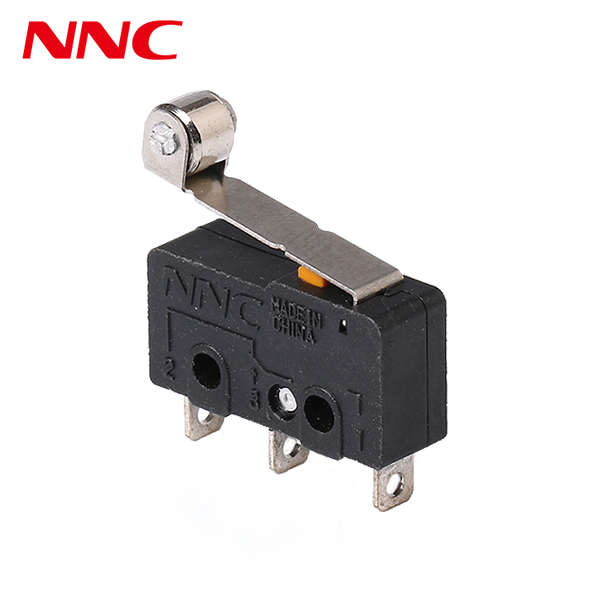
Electrical parameters keep the circuit safe, but mechanical parameters ensure physical functionality. If the actuator dimensions or force profiles misalign, the best electrical contacts in the world will not help.
Evaluating physical dimensions requires looking at standard, miniature, and subminiature form factors. Standard switches offer high power ratings and rugged terminals. Miniature models balance moderate power handling with reduced space. Subminiature profiles push miniaturization to the extreme.
You must carefully consider contextual integration. Hardware teams often need to source a high reliability subminiature micro switch for applications where space is extremely limited but failure is not an option. Automotive door latches, compact IoT security sensors, and portable medical infusion pumps represent prime examples. These applications demand zero-defect precision in a package often no larger than a fingernail.
Matching the mechanical actuation profile to your physical driving mechanism dictates product longevity.
Operating Force (OF): This measures how much pressure is needed to snap the internal mechanism. You must match the OF to your driving mechanism. If the force is too high, a lightweight plastic cam might bend or fail to trigger the switch. If the force is too low, heavy vibration might cause false actuations.
Pre-travel and Over-travel: Pre-travel indicates the distance the actuator moves before the electrical circuit changes state. Over-travel refers to the safe distance the actuator can continue moving after state change. Calculating your mechanical tolerances guarantees you will not crush the switch housing during maximum actuation travel.
The interface between your machine and the switch determines which actuator style to select. Direct linear pushes require different hardware than sliding cams.
Actuator Type | Best Application Use Case | Common Mechanical Interface |
|---|---|---|
Pin Plunger | High-precision detection with minimal travel space. | Direct, straight-line pushing mechanisms. |
Hinge Lever | Applications requiring broader mechanical tolerances. | Slow-moving cams or wide-angle triggering. |
Roller Lever | High-friction environments requiring smooth transition. | Fast-sliding cams or rotational machine parts. |
A switch operates flawlessly in a climate-controlled laboratory. Placed outdoors or inside a dusty factory, that same component might fail within weeks. Environmental resilience requires proactive specification.
You must assess the actual environment. Will the product face heavy dust? Will operators spray it down with water? Will it sit in highly humid conditions where condensation forms inside enclosures? Will it encounter corrosive gases in agricultural or chemical processing facilities? Answering these questions narrows your selection criteria immediately.
Ingress Protection (IP) ratings govern how well a component blocks solid particles and liquids.
An IP67-rated sealed micro switch is mandatory for outdoor equipment, automotive exterior applications, and white goods like washing machines. IP67 ensures the internal contacts remain completely protected against heavy dust and temporary water immersion. Epoxy resins and specialized rubber gaskets achieve this seal.
You must acknowledge the trade-off. Sealed switches generally exhibit different operating force profiles because the internal rubber seals add mechanical resistance. They also carry higher unit costs compared to standard unsealed IP40 variants. If your application resides safely inside a dry, sealed primary enclosure, an IP40 switch might suffice perfectly.
Always verify standard operating temperature ranges against your real-world requirements. Most standard plastic housings warp or melt under extreme heat. Standard internal lubricants freeze solid under extreme cold. If you design commercial ovens, HVAC systems, or aerospace equipment, you will need custom high-temp requirements. These rely on specialized thermoset plastics, silicone rubber components, and high-performance metal alloys designed to withstand massive thermal cycling.
Datasheets enthusiastically promote massive lifecycle numbers. Without careful interpretation, these numbers mislead engineers and create false confidence regarding product longevity.
You must clarify the fundamental difference between mechanical life and electrical life.
Mechanical life represents testing without any electrical load. The manufacturer simply physically clicks the switch actuator until a spring breaks or a hinge fails. This number often reaches 1 million to over 10 million cycles. Electrical life tests the switch under a full rated electrical load. Arc degradation, contact pitting, and material transfer occur rapidly. Electrical life typically peaks between 50,000 to 100,000 cycles. Electrical life always dictates the true lifespan of your functioning circuit.
Theoretical lifespan degrades quickly when exposed to actual operating conditions. Several factors accelerate contact attrition.
Cycle frequency: Rapid clicking generates trapped heat. High actuation frequency prevents the internal contacts from cooling down, accelerating metal fatigue.
Environmental vibration: Continuous vibration causes micro-fretting on the contact surfaces, wearing away precious metal platings prematurely.
Peak load surges: Occasional voltage spikes or short-circuit events instantly vaporize microscopic amounts of contact material, significantly reducing remaining life.
To avoid over-paying for unnecessary durability, follow this systematic framework to calculate acceptable failure rates.
Define the expected warranty period of your end product in years.
Estimate the maximum number of daily actuations the end-user will trigger.
Multiply the daily actuations by the total days in the warranty period to find the required baseline cycle count.
Apply a safety margin multiplier (typically 1.5x to 2.0x) to account for real-world attrition factors like vibration and temperature shifts.
Compare this final calculated requirement directly against the supplier's stated electrical life at your specific load voltage and current.
The highest quality component design means nothing if the manufacturer cannot produce it consistently. Evaluating your manufacturing partner is just as critical as evaluating the component itself.
Your chosen micro switch supplier must provide easily traceable global agency approvals. These certifications verify safety and compliance. Look for UL or cUL marks for North American market entry. Require ENEC certifications for European distribution. Mandate CQC marks for Chinese market compliance. Traceable certifications prevent customs delays, protect against liability in case of end-user injury, and ensure baseline material safety.
Off-the-shelf components rarely fit perfectly into highly customized mechanical assemblies. Evaluate whether the supplier maintains agile tooling capabilities. Can they modify lever shapes quickly? Can they integrate specific wire harnesses directly onto the switch terminals? Will they alter terminal angles for easier PCB insertion? Prioritize partners who execute these modifications without demanding excessive NRE (Non-Recurring Engineering) costs or unreasonable minimum order quantities.
Marketing claims require empirical validation. Look for manufacturing partners who operate certified internal test laboratories. Ask them to provide specific test lab reports for the batches you intend to buy. Key reports include RoHS compliance data for environmental safety, salt spray testing logs for corrosion resistance, and specific electrical lifecycle testing graphs. Validating datasheet claims through raw data protects your brand reputation.
Sourcing the correct micro switch requires a balanced evaluation of electrical loads, physical constraints, and environmental realities. Overlooking wetting currents, IP rating trade-offs, or mechanical tolerances guarantees premature failure in the field.
Do not rely solely on top-line datasheet numbers. Always prototype with physical samples evaluated in actual operating conditions before authorizing mass production. Environmental heat, humidity, and mechanical vibration will expose flaws that theoretical calculations miss.
Your immediate next steps involve consulting directly with supplier application engineers. Request 3D CAD models to verify mechanical fit within your housing. Finally, secure all necessary compliance and test documentation to protect your production timeline.
A: The failure stems from oxidation buildup. Standard silver contacts require a higher minimum current, known as wetting current, to generate a small arc that burns off surface oxidation. A low 5mA logic signal cannot pierce this sulfide layer, creating an open circuit. You require gold-plated contacts for 5mA applications.
A: The distinction lies in strict dimensional standards. Subminiature switches are significantly smaller, often comprising half the volume of a miniature switch. Engineers use subminiature profiles in highly constrained spaces like aerospace equipment or IoT devices, which requires specialized precision manufacturing to maintain reliable internal clearances.
A: You can only trust them as a baseline for physical integrity without an electrical load. Mechanical life ignores electrical arcing. The true, usable lifespan of the component must always be evaluated using the much lower electrical life rating under your specific load and environmental conditions.

 注: 建议图片大小150px*50px


