Views: 175 Author: Site Editor Publish Time: 2026-07-06 Origin: Site


High-voltage DC applications in modern energy storage systems face severe arcing risks during routine load switching. Unlike AC power, direct current lacks a natural zero-crossing point. This constant electrical flow means arcs sustain themselves longer. Engineers consider arc extinguishment a critical failure point in system design. We look to the magnetic blow-out mechanism as a proven mechanical solution. It safely stretches and severs high-energy DC arcs. This article moves past basic definitions to give you a pragmatic evaluation framework. You will learn how to specify the correct switching components for battery energy storage, solar inverters, and electric vehicle infrastructure. We detail polarity requirements, specific load characteristics, and physical mounting constraints. This ensures you maintain long-term system stability without over-engineering your initial design.
Magnetic blow-out mechanisms offer a robust alternative to sealed gas-filled contactors, particularly in applications where gas leakage is a long-term failure risk.
Selecting the right energy storage relay requires aligning the relay's polarity (polarized vs. non-polarized) with the bi-directional power flow of the system.
Evaluation must move beyond baseline voltage/current ratings to include clearing time, contact wear under inductive loads, and compliance with UL/IEC safety standards.
Permanent magnets sit adjacent to the electrical contacts inside these devices. When the contacts pull apart, an electrical arc ignites across the gap. The magnets generate a localized magnetic field perpendicular to the arc path. The resulting Lorentz force pushes the conductive plasma arc outward into a dedicated arc chute. The chute forces the arc to stretch, hit cooling fins, and lose thermal energy rapidly. This physical mechanism acts as a highly reliable arc suppression relay. You do not rely on vacuum integrity to extinguish the flame.
You must compare this mechanical approach against hermetically sealed gas-filled relays. Gas-filled units use hydrogen or nitrogen gas mixtures to smother the arc. They perform exceptionally well on day one. However, energy storage systems often operate for ten to fifteen years. Over time, the epoxy seals slowly degrade. Gas molecules permeate outward. Oxygen leaks inward. This silent degradation compromises the dielectric strength. You cannot easily detect a leaked seal until the relay fails catastrophically under load. Magnetic blow-out designs rely entirely on mechanical wear. Contact erosion happens at a predictable rate. Your engineers can model this wear and schedule maintenance accurately.
Procurement teams must evaluate the cost-to-performance ratio carefully. Sealed gas contactors require complex manufacturing environments. This drives up the initial purchase price. Magnetic blow-out models offer distinct upfront cost advantages. They utilize robust, ambient-air enclosures. They excel in high-cycle environments like grid-tied solar inverters. By accepting slightly larger physical dimensions, you gain a rugged component. You mitigate the hidden risks of gas depletion entirely.
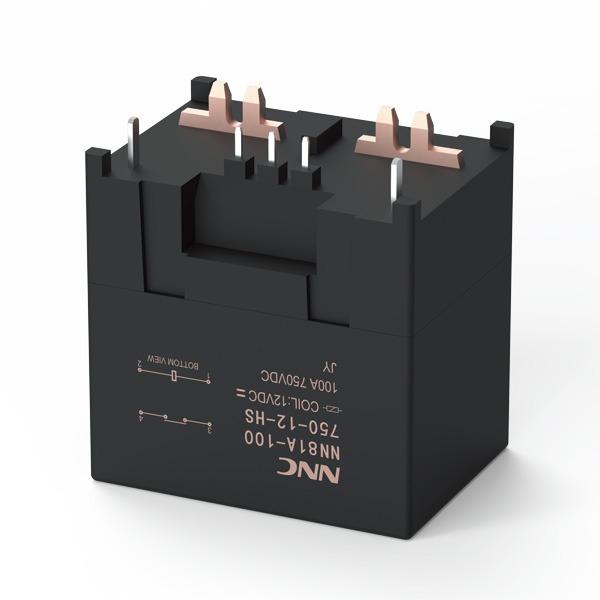
Modern battery energy storage systems (BESS) routinely charge and discharge. This operational cycle pushes current in two distinct directions. You must understand how this impacts internal arc suppression. Polarized relays utilize a simplified magnetic layout. They only push the arc correctly when current flows in one specific direction. If you send reverse current through a polarized unit, the magnetic field pushes the arc away from the chute. The plasma can melt the internal plastic housing instantly. Polarized units are cheaper to manufacture. You specify them only for strict unidirectional circuits.
Non-polarized relays utilize a complex magnetic architecture. They direct the arc safely into the chute regardless of the current direction. Battery storage banks demand this bi-directional capability. Sizing the correct energy storage relay requires a strict audit of your system's power flow paths. A common mistake is buying polarized units for a bidirectional battery rack to save upfront budget.
Engineers often confuse continuous carry current and make/break current. Continuous carry current dictates the thermal limits of the closed contacts. Make/break current defines what the relay can safely switch under normal operating loads. Short-circuit withstand capabilities define how the unit behaves during a catastrophic system fault. You must specify your high voltage relay to handle the absolute worst-case emergency disconnect scenario.
Avoid over-engineering the continuous carry rating excessively. Oversized contacts require heavier armatures. Heavier armatures require higher coil driving power. They also suffer from worse contact bounce during closure.
Rating Parameter | Engineering Definition | Impact on ESS Architecture |
|---|---|---|
Continuous Carry Current | Maximum current the closed contacts can carry without overheating. | Determines the baseline thermal management required inside the cabinet. |
Make/Break Switching Current | Current level the relay can safely open or close repeatedly. | Dictates the expected mechanical lifecycle of the contact pads. |
Short-Circuit Withstand | Current spike the relay can survive closed before welding shut. | Defines safety margins during a catastrophic dead-short event. |
Solar inverters and lithium-ion battery banks present entirely different load profiles. Solar inverter inputs often act as highly capacitive loads. Capacitors draw massive inrush currents upon initial connection. This sudden spike can easily weld relay contacts together. Battery banks often present highly inductive loads during fault clearing. Inductors resist sudden changes in current flow. When you break an inductive load, the circuit generates a massive voltage spike. This spike elongates the arc duration significantly. You must apply strict derating factors to your relay choice depending on the specific load type.
Specifying the electrical parameters is only half the battle. Physical installation constraints dictate long-term success. Because these components rely on internal permanent magnets, physical proximity matters.
If you mount multiple relays flush against each other, their magnetic fields bleed outward. This external flux causes severe magnetic interference. The interfering fields can weaken or skew the internal blowout trajectory of adjacent units. An altered trajectory means the arc might fail to reach the cooling fins. The arc sustains itself and destroys the contacts. You must strictly follow manufacturer keep-out zones. Always space these components according to the recommended clearance guidelines.
Mounting orientation also impacts performance directly. Ambient air-based arc chutes rely partially on fluid dynamics. Hot plasma naturally rises. Gravity plays a role in moving the superheated air. If you mount the component upside down, you force the arc to fight gravity. This drastically reduces the clearing efficiency. Standard engineering assumptions usually assume an upright, vertical orientation.
Footprint restrictions plague modern enclosure designs. You often install a new energy relay inside a highly compact electric vehicle charger. Space is a premium luxury. Mechanical blowout models require adequate thermal dissipation zones. You must factor air circulation into your CAD software early.
Maintain a minimum 50mm clearance gap between high-voltage magnetic blowout components.
Ensure the arc chute vents face away from sensitive microelectronics or wiring harnesses.
Verify orientation guidelines before finalizing the internal enclosure mounting brackets.
Shield nearby Hall-effect sensors to prevent false readings caused by stray magnetic flux.
A systematic specification process prevents expensive field failures. Do not rely solely on top-line datasheet numbers. Follow a stringent procurement framework to ensure you purchase the right component for the job.
First, explicitly define your system's operational envelope. Map the maximum nominal operating voltage. Calculate the absolute peak fault current your batteries can deliver. Estimate the required mechanical switching cycles versus electrical switching cycles. Mechanical cycles occur without a live load. Electrical cycles dictate actual arc-bearing lifespan. Define these numbers clearly before speaking to a supplier.
Next, audit the exact power flow layout. Trace the current path during a rapid charging state. Trace the current path during a heavy discharge state. This audit determines your strict polarity requirements. Never guess on polarity.
Third, verify regional regulatory compliance. An industrial DC relay must carry specific safety marks. Ensure the unit complies with UL 60947-4-1 for North American markets. Verify IEC 61810 compliance for European deployments. Missing certifications will halt your final product launch indefinitely.
Finally, never commit to a volume order without extensive physical validation. Standardized sample testing isolates poor manufacturing quality early.
Baseline Resistance Check: Measure the milliohm contact resistance on the unpowered, brand-new sample.
Load Bank Switching: Cycle the component at your calculated continuous carry current for 100 cycles.
Thermal Imaging: Use an infrared camera to monitor housing temperatures during the make/break cycles.
Post-Test Resistance: Re-measure contact resistance to calculate carbon buildup and contact erosion.
A properly specified magnetic blow-out high voltage relay will exhibit minimal thermal spiking during these tests. You will see a small, predictable increase in resistance. You will not see housing deformation or sustained arc flashes.
Specifying a reliable switching component requires moving beyond basic voltage ratings. You must actively balance bi-directional current needs against internal magnet polarity. You must manage physical installation constraints like magnetic interference and orientation. Prioritizing predictable, mechanical arc suppression over sealed gas alternatives provides distinct long-term advantages. The mechanical approach eliminates the hidden threat of slow gas permeation.
We encourage design engineers and procurement teams to collaborate closely early in the design phase. Download a comprehensive manufacturer design guide. Request specific datasheet performance curves. Consult directly with an application engineer to review your exact battery energy storage schematic before finalizing your bill of materials.
A: Technically yes, but at a significantly reduced capacity and a much higher risk of catastrophic failure. The internal magnetic field blows the reverse arc away from the safety chute. The plasma will rapidly melt internal components. Always specify a non-polarized model for bi-directional systems.
A: Paschen's Law dictates that lower air density at high altitudes reduces the overall dielectric strength of the air gap. The ambient air becomes less effective at cooling and breaking the arc. You must derate the maximum voltage specification or utilize a model with larger physical contact gaps for high-altitude deployments.
A: You should expect realistic milliohm increases due to arcing-induced carbonization on the contact pads. Resistance often rises from a baseline of 1-3 milliohms up to 10-15 milliohms over thousands of cycles. Your Battery Management System (BMS) should actively monitor this resulting voltage drop to trigger scheduled maintenance.

 注: 建议图片大小150px*50px


